
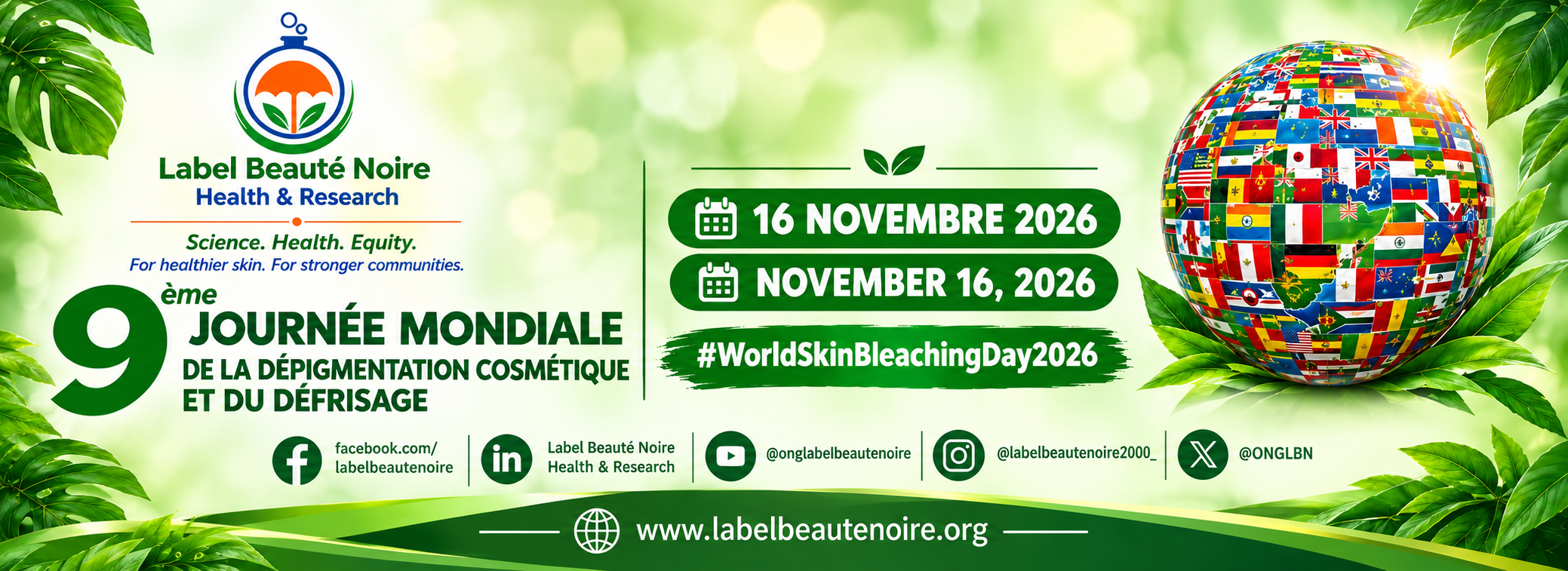
9th World Day for the Prevention of Cosmetic Skin Lightening and Hair Straightening
16 NOVEMBER 2026
Article in partnership with Afrique Education magazine :
Strengthening prevention and promoting responsible cosmetics communication
On the occasion of the 9th World Day for the Prevention of Cosmetic Skin Lightening and Hair Straightening, Label Beauté Noire Health & Research calls for stronger prevention measures, increased vigilance regarding products placed on the market, and improved quality of information provided to consumers. Women and children, particularly pregnant women and young children, must receive special attention in information and prevention initiatives.
Health risks go beyond mercury
Health alerts concerning certain skin-lightening products do not relate to mercury alone. They also call for scrutiny of the possible presence of lead and other contaminants, as well as the use of prohibited substances or substances diverted from their intended use, such as hydroquinone in skin-lightening cosmetics or certain corticosteroids. The presence of a substance and the level of risk must be assessed in light of the product’s composition, concentration, exposure and applicable regulatory framework.
Online sales: strengthening vigilance and accountability
Studies conducted by the European Environmental Bureau (EEB) and the Zero Mercury Working Group have documented the online sale of skin-lightening creams containing mercury concentrations incompatible with applicable requirements. These findings highlight the challenges involved in market surveillance and the need for stronger cooperation between public authorities, e-commerce platforms, social media networks, sellers and civil society organisations. Social media promotion may also direct consumers towards sales channels outside the platforms themselves.
Responsible communication: accurate and verifiable claims
Packaging, advertising, online sales websites and influencer publications must provide fair, understandable and substantiated information. A statement such as “mercury-free”, “hydroquinone-free” or “natural” is not, on its own, sufficient to demonstrate the overall safety or quality of a product. Claims must comply with the regulations applicable to cosmetics and must not mislead the public. European Directive 2024/825, known as the EmpCo Directive, notably strengthens efforts to combat certain misleading commercial practices relating to environmental claims and sustainability labels.
A shared responsibility
Label Beauté Noire Health & Research calls on brands, distributors, beauty professionals, influencers and digital platforms to support reliable information, verify the claims being communicated and strengthen vigilance regarding non-compliant products. Prevention must be based on scientific knowledge, alerts issued by public authorities and field experience, while respecting the respective responsibilities and mandates of each institution.
“Beauty should never put health at risk.”
Ms Isabelle Mananga Ossey Director of Environmental Communication Label Beauté Noire Health & Research Website: www.labelbeautenoire.org | #WorldSkinBleachingDay26
DOCUMENTARY REFERENCES
• WHO, Mercury in Skin Lightening Products (2019)
https://www.who.int/publications/i/item/WHO-CED-PHE-EPE-19.13
• UNEP / Global Mercury Partnership, Mercury in Skin Lightening Products
https://www.unep.org/globalmercurypartnership/resources/report/mercury-skin-lightening-products
• Minamata Convention, Mercury in Cosmetics
https://minamataconvention.org/en/topics/mercury-cosmetics
• European Environmental Bureau / Zero Mercury Working Group, Online Marketing of Toxic Skin Lighteners
https://eeb.org/en/library/online-marketing-of-toxic-skin-lighteners/
• Directive (EU) 2024/825 (EmpCo)
https://eur-lex.europa.eu/legal-content/EN/TXT/?uri=CELEX:32024L0825
• Commission Regulation (EU) No 655/2013 establishing common criteria for the justification of claims used in relation to
cosmetic products https://eur-lex.europa.eu/eli/reg/2013/655/oj